
Windows Boot Repair
How to Fix “BootDevice Not Found” Hard Disk (3F0) Error in Windows
If your computer shows “BootDevice Not Found,” “Please install an operating system on your hard disk,” or “Hard Disk - (3F0),” first check whether the hard disk or SSD is detected and healthy. If the disk is detected but Windows still cannot boot, repair the Windows boot files with Lazesoft One Click Fix or Windows recovery commands.
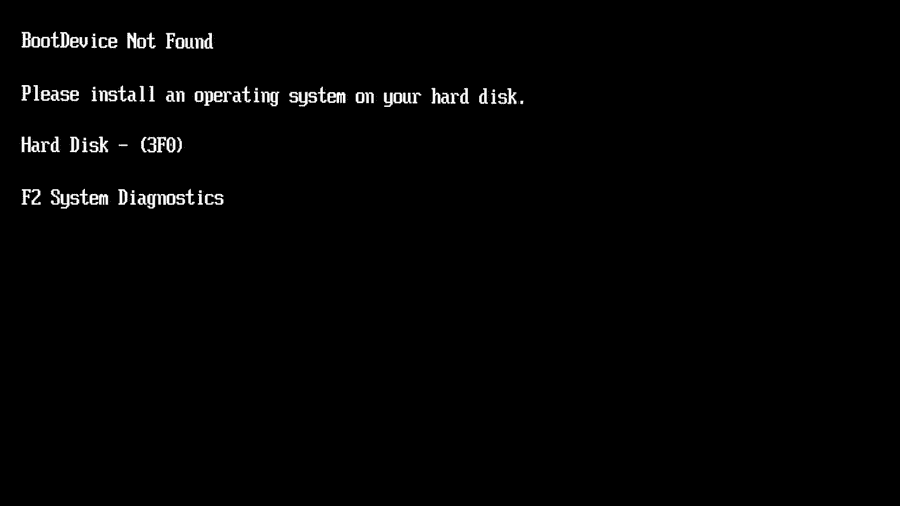
When starting the computer, you may see a black-screen error similar to this:
BootDevice Not Found
Please install an operating system on your hard disk.
Hard Disk - (3F0)
F2 System Diagnostics
This error means the computer cannot find a bootable operating system on the selected disk. It does not always mean Windows has been deleted. In many cases, Windows is still on the hard disk or SSD, but the computer cannot start it because of a wrong boot order, incorrect UEFI/Legacy boot mode, damaged boot files, corrupted BCD configuration, storage controller setting changes, or a disk detection problem.
Video Guide: Fix BootDevice Not Found with Lazesoft One Click Fix
Watch this video to see how to repair the BootDevice Not Found problem using the One Click Fix feature in Lazesoft Recovery Suite Home Edition.
After watching the video, continue with the steps below to check diagnostics, BIOS/UEFI settings, boot order, and repair options.
Free Policy for Home Users
Lazesoft Recovery Suite Home Edition is free for home users. Home users can create a Lazesoft bootable recovery USB and use Windows Recovery features such as One Click Fix to repair common Windows boot problems.
For business, technician, commercial service, or Windows Server environments, please choose the appropriate Professional, Technician, or Server edition.
Step 1: Run System Diagnostics First
If the error screen offers F2 System Diagnostics, press F2 and run the hard drive or storage test first. This is especially important when the message includes Hard Disk - (3F0).
Diagnostics passed
If the disk passes diagnostics and is detected in BIOS/UEFI, the problem is more likely caused by boot order, boot mode, boot files, BCD, or partition configuration.
Diagnostics failed
If the disk fails diagnostics, do not keep running repair commands repeatedly. The disk may be failing. Back up or recover important files first, then replace the drive if necessary.
No disk detected
If the diagnostics tool or BIOS/UEFI cannot see the disk, check the disk connection, NVMe installation, SATA cable, storage controller setting, or possible disk failure before repairing Windows.
Recent hardware change
If the error appeared after replacing, cloning, or upgrading a disk, check whether the new disk is first in boot order and whether the partition style matches the boot mode.
Important: Software boot repair can help only when the computer can detect the Windows disk. If BIOS/UEFI cannot detect the hard disk or SSD, fix the hardware or firmware detection problem first.
Step 2: Check BIOS/UEFI Settings
Restart the computer and enter the BIOS/UEFI setup screen. Common keys include F2, Del, Esc, F10, and F12. Press the key immediately after powering on the computer.
1. Is the hard disk or SSD listed?
If the disk is not listed, check the SATA cable, power cable, NVMe slot, RAID/AHCI/Intel RST/Intel VMD setting, or possible disk failure. Boot repair should wait until the disk is detected.
2. Is the Windows disk first?
If the computer tries to boot from the wrong disk, USB drive, memory card, or external hard drive, it may show BootDevice Not Found. Put the Windows disk or Windows Boot Manager first.
3. Is the boot mode correct?
Windows installed on a GPT disk usually boots in UEFI mode. Windows installed on an MBR disk usually boots in Legacy/CSM mode.
4. Disconnect extra devices
Remove unnecessary USB drives, external disks, memory cards, and bootable devices. Then restart the computer and test again.
Common Causes of BootDevice Not Found / Hard Disk (3F0)
After the disk is detected and appears healthy, this error is often caused by one of the following boot problems:
- Wrong boot order or wrong boot device selected
- BIOS/UEFI boot mode changed from UEFI to Legacy/CSM, or from Legacy/CSM to UEFI
- Damaged MBR on a Legacy/MBR system
- Damaged boot sector or boot sector parameters
- Incorrect active/system partition on a Legacy/MBR system
- Corrupted or missing BCD file
- Missing EFI boot files on a UEFI/GPT system
- File system errors on the boot partition
- Boot configuration damaged after disk clone, restore, repartitioning, Windows update, or power failure
- Storage controller mode changed, such as AHCI, RAID, Intel RST, or Intel VMD
Use Lazesoft One Click Fix
Recommended if the disk is detected and you want an automatic repair method for common MBR, boot sector, BCD, boot files, and boot registry settings problems.
Use Windows Commands
Recommended for advanced users who can identify the Windows partition and EFI/System Reserved partition correctly.
Method 1: Repair BootDevice Not Found with Lazesoft One Click Fix
If you do not want to manually identify partitions and type commands, use Lazesoft Recovery Suite Home Edition or Lazesoft Windows Recovery Home Edition. The One Click Fix feature can automatically check and repair common Windows boot problems. You can also watch the video guide above to see the process before following the steps below.
Step 1: Boot from a Lazesoft Recovery USB Disk
Boot the problem computer from a Lazesoft recovery USB disk. After Lazesoft Recovery Suite starts, select Windows Recovery from the main screen.
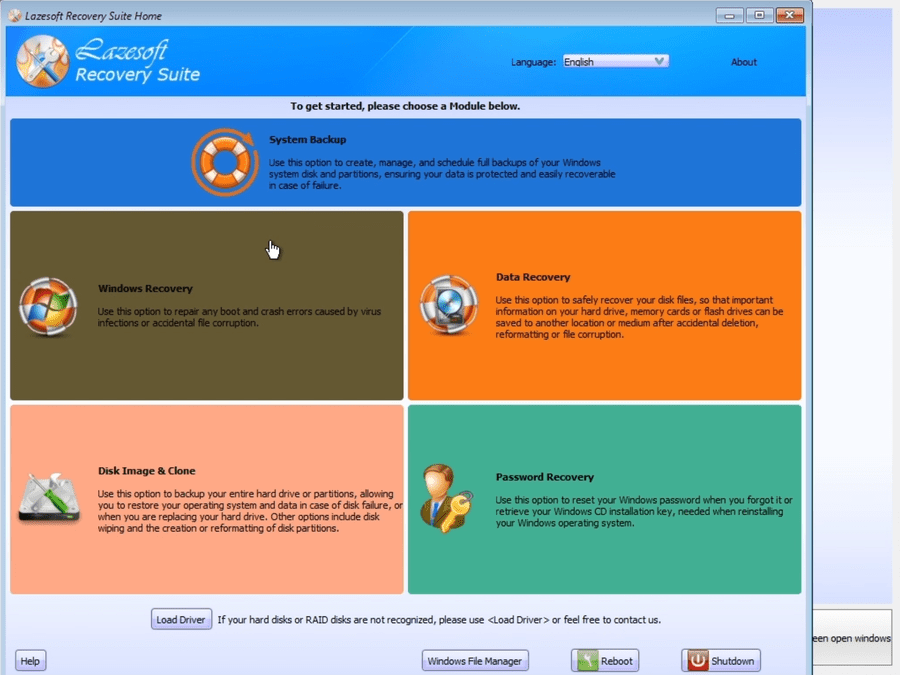
Step 2: Choose One Click Fix Crash Solution
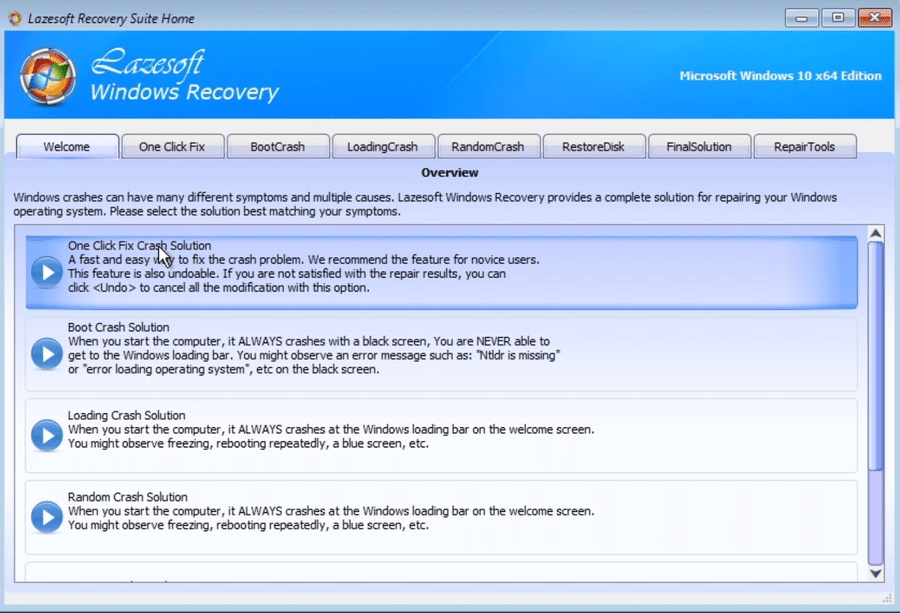
In Lazesoft Windows Recovery, choose One Click Fix Crash Solution. This option is designed for common Windows boot and crash problems.
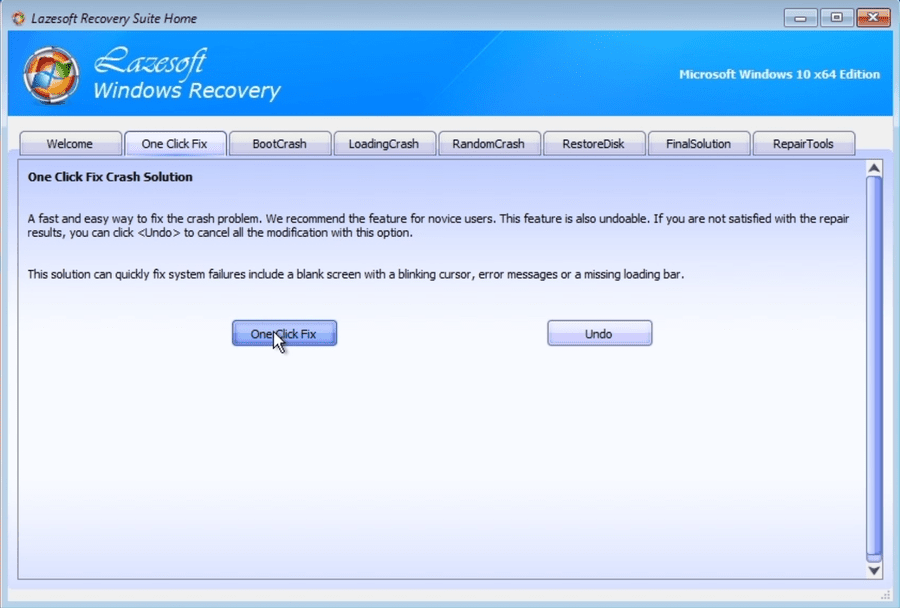
Then click the One Click Fix button.
Step 3: Select the Windows Installation
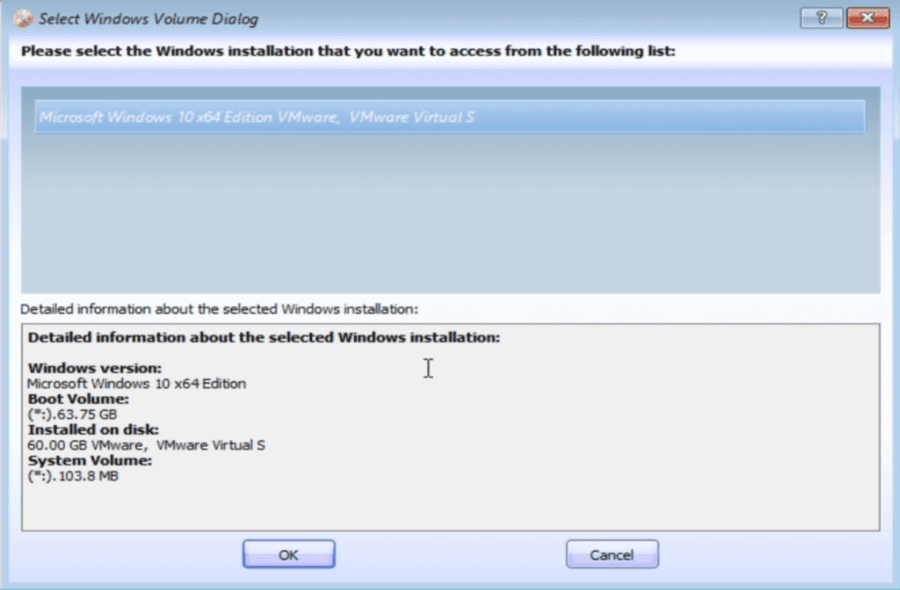
If Lazesoft finds more than one Windows installation, select the correct Windows installation you want to repair. Check the Windows version, boot volume, disk size, and system volume information carefully before continuing.
Step 4: Run One Click Fix
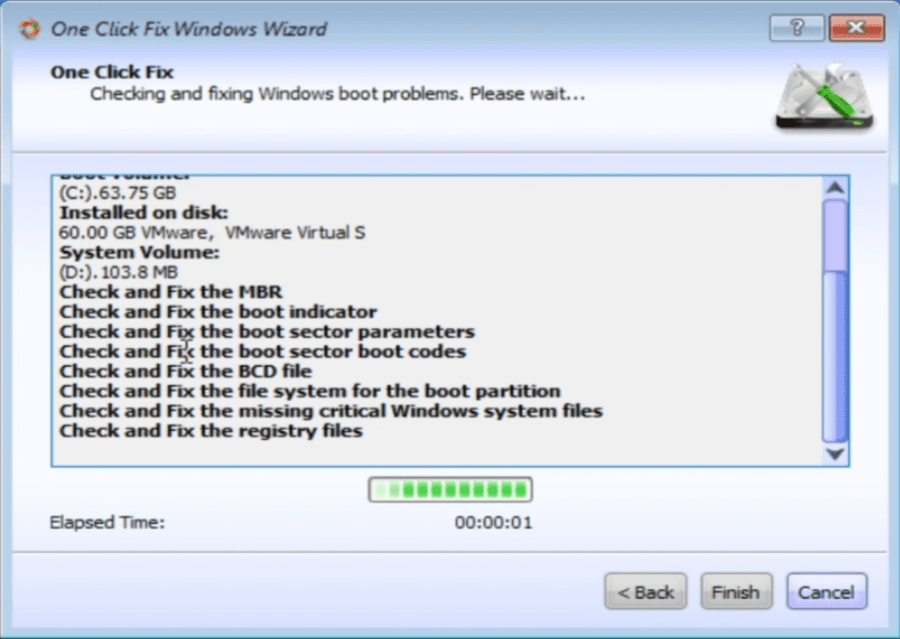
Lazesoft One Click Fix will check and repair common Windows boot problems automatically. It may check and fix the MBR, boot indicator, boot sector parameters, boot sector boot code, BCD file, file system on the boot partition, missing critical Windows system files, and Windows boot-related registry files.
Step 5: Reboot and Test
After the repair is completed, click Finish, remove the Lazesoft USB disk, and restart the computer. If the repair is successful, Windows should start normally again.
Method 2: Repair the Error Using Windows Commands
This method uses Windows Recovery Environment or a Windows installation USB disk. It is suitable for advanced users who are comfortable identifying partitions and running command-line tools.
Step 1: Boot into Command Prompt
Boot the computer from a Windows installation USB disk. On the Windows Setup screen, click:
Repair your computer → Troubleshoot → Advanced options → Command Prompt
Do not click Install now.
Step 2: Find the Windows Partition
Drive letters in Windows Recovery Environment may be different from normal Windows. Run:
diskpart
list volume
Look for the Windows partition. It is usually a large NTFS partition. Exit DiskPart:
exitThen test possible drive letters:
dir C:\Windows
dir D:\Windows
dir E:\Windows
Use the drive letter that contains the Windows folder. In the examples below, we assume the Windows partition is C:. If your Windows partition is D:, replace C:\Windows with D:\Windows.
Repair Method A: For UEFI/GPT Systems
UEFI / GPT
Use this method if Windows was installed in UEFI mode and the disk uses GPT. Most modern Windows 10 and Windows 11 computers use UEFI/GPT.
Find the small FAT32 EFI System Partition, usually around 100 MB to 300 MB:
diskpart
list volume
Assign the EFI System Partition a drive letter:
select volume X
assign letter=S:
exit
Replace X with the correct EFI partition volume number. Then rebuild the EFI boot files:
bcdboot C:\Windows /s S: /f UEFIIf the command succeeds, you should see:
Boot files successfully created.Restart the computer:
wpeutil rebootRepair Method B: For Legacy BIOS / MBR Systems
Legacy / MBR
Use this method if Windows was installed in Legacy/CSM mode and the disk uses MBR.
bootrec /fixmbr
bootrec /fixboot
bootrec /scanos
bootrec /rebuildbcd
If bootrec /fixboot shows Access is denied, you can continue by rebuilding the boot files with bcdboot.
If there is a System Reserved partition
diskpart
list disk
select disk 0
list partition
Find the small System Reserved partition. It is usually NTFS and around 100 MB to 600 MB. Select it and mark it active:
select partition X
active
assign letter=S:
exit
Replace X with the correct System Reserved partition number. Then rebuild boot files:
bcdboot C:\Windows /s S: /f BIOSwpeutil rebootIf there is no System Reserved partition
If Windows is installed directly on the active system partition, mark the Windows partition active and rebuild boot files:
diskpart
list disk
select disk 0
list partition
select partition X
active
exit
Replace X with the Windows partition number. Then run:
bcdboot C:\Windows /s C: /f BIOSwpeutil rebootOptional: Check the File System
If the boot partition has file system errors, run:
chkdsk C: /fIf your Windows partition uses a different drive letter in Windows Recovery Environment, replace C: with the correct letter.
chkdsk D: /fImportant: Do not guess the EFI partition, System Reserved partition, or Windows partition. Using the wrong partition may make boot repair more difficult. If the disk uses BitLocker, you may need to unlock the Windows partition before repairing it.
Special Case: BootDevice Not Found After Clone or SSD Upgrade
If the error appears after cloning Windows to a new HDD, SSD, or NVMe drive, check these items before assuming the clone failed:
- Make sure the cloned disk is selected as the first boot disk.
- For a GPT target disk, boot the computer in UEFI mode and choose Windows Boot Manager for that disk.
- For an MBR target disk, boot the computer in Legacy/CSM mode and make sure the correct system partition is active.
- If the old and new disks are both connected, temporarily disconnect the old disk and test again.
- If the clone was made to NVMe, confirm the computer supports booting from NVMe and that the storage controller setting is correct.
- If Windows boot files were not created on the new disk, rebuild them with Lazesoft One Click Fix or the
bcdbootcommand.
For more clone-related boot problems, see Fix 0x7B After Clone and Fix Windows Black Screen After Clone.
Reboot and Test Windows
After repairing the boot files, remove the recovery USB disk and restart the computer.

What If BootDevice Not Found Still Appears?
- Run system diagnostics again and check whether the disk passes.
- Confirm the Windows disk is still listed in BIOS/UEFI.
- Check whether the correct disk or Windows Boot Manager entry is first in the boot order.
- Confirm the correct boot mode: UEFI for GPT or Legacy/CSM for MBR.
- Disconnect extra USB drives, external disks, and memory cards.
- If the computer uses RAID, Intel RST, Intel VMD, or a special storage controller, make sure the correct storage driver is available in the recovery environment.
- If the disk shows warning signs, clicking sounds, slow detection, or diagnostics failure, back up or recover important data before continuing.
- If Windows was cloned or restored to a new disk, check whether the target disk uses the expected partition style and contains the required EFI/System Reserved boot partition.
Which Method Should You Use?
| Situation | Recommended action |
|---|---|
| Disk is not detected in BIOS/UEFI | Check hardware connection, NVMe/SATA installation, BIOS storage settings, or disk failure before using boot repair. |
| Disk fails diagnostics | Back up or recover important files first. Replace the disk if necessary. |
| Disk is detected but Windows will not boot | Use Lazesoft One Click Fix or Windows commands to repair boot files and BCD. |
| Error appeared after clone or SSD upgrade | Check boot order, UEFI/Legacy mode, partition style, EFI/System Reserved partition, and rebuild boot files if needed. |
FAQ
Does BootDevice Not Found mean my hard drive is dead?
Not always. The disk may be healthy but not bootable because of a wrong BIOS/UEFI setting, wrong boot order, damaged boot files, or corrupted BCD configuration. However, if diagnostics fail or the disk is not detected, hardware failure is possible.
What does Hard Disk - (3F0) mean?
It means the computer did not find a bootable operating system on the selected hard disk or SSD. You should run system diagnostics, check disk detection, check boot order, and then repair Windows boot files if the disk is detected.
Can Lazesoft One Click Fix repair BootDevice Not Found?
Yes, if the Windows disk is detected and the problem is caused by common boot configuration issues such as MBR, boot sector, BCD, missing boot files, file system problems on the boot partition, or boot-related registry settings.
Can software repair help if the disk is not listed in BIOS?
No. If the disk is not detected by BIOS/UEFI, first check the disk connection, storage controller setting, NVMe/SATA installation, or possible disk failure.
Is this error similar to “An operating system wasn’t found”?
Yes. The first checks are similar: disk detection, boot order, boot mode, and boot file repair. The BootDevice Not Found / Hard Disk (3F0) message is often shown by HP-style firmware screens and should be checked with system diagnostics first.
Fix Windows Boot Problems with Lazesoft Recovery Suite Home Edition
Lazesoft Recovery Suite Home Edition is free for home users and includes Windows Recovery tools for repairing common Windows boot problems.